HYDROLOGICAL CYCLE
Hydrology studies the distribution of water on Earth's surface, its interaction with other natural substances and the role it plays in plant and animal life. The continuous exchange of water between land and atmosphere is called the hydrological cycle. By the work of several factors, first of all the heat from the Sun , water evaporates from the soil, bodies of water and living organisms, and then condense and fall as rain or snow.
The water cycle technically known as hydrological cycle is the movement of water in Earth's hydrosphere, including changes in the physical state of water between liquid, solid and gaseous.
The hydrosphere is the set of all water on Earth:
• Those contained in the concave parts of the earth's surface (oceans, seas and lakes).
• Those that flow freely on the ground (runoff).
• Those gathered in the beds of watercourses (runoff).
• The waters that flow underground (groundwater flow).
• The water retained in solid form, in snow and glaciers .
WATER TANKS
About 1.4 billion square kilometers, is the amount of water present nell'idrosfera. In seas and oceans is over 96% water on Earth. The glaciers, the ice caps, flakes groundwater aquifers , the waterways, the lakes and the atmosphere are the 3.6% water on our planet. The water of most interest to man is the freshwater .
All water tanks are in a state of dynamic equilibrium, which means that they receive ongoing contributions from other tanks. The continuous transition from one tank to another is defined as hydrological cycle.
The water cycle is divided into 5 phases :
1. evaporation. This process absorbs much solar energy is to move the liquid to the gaseous water. A similar process is the transpiration, ie the escape of moisture from the leaves of plants and animals from the body.
2. Condensation . It is the return of liquid water. Occurs when the steam cools, giving birth to tiny droplets that make up the clouds.
3. Precipitation . Is the return water from the clouds ( rain, snow , hail, fog and dew ). 80% of precipitation falls into the sea, while 20% falls on the continents.
4. Infiltration . Indicates the water absorbed by plant roots, also includes water that penetrate.
5. Runoff . It consists of the slope to the sea in excess, fall on the continental areas. The flow takes place most often on the surface of the lithosphere ( runoff), while the portion that is in the ground is called ( groundwater flow).
volume in fresh water reserves, particularly those available for use by man, is the important water resources.
THE EFFECTS OF GLOBAL WARMING IN ITALY
Over the past 20 years the weather-climate in Italy has had some change at times of particular concern, with a reduction in rainfall especially in those regions of the country where water availability depends primarily on surface water and spring water and therefore groundwater.
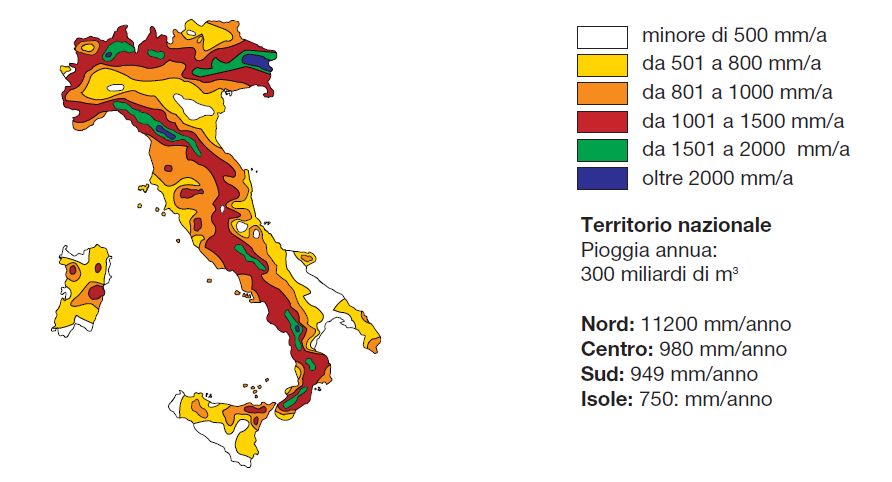
Italy is a country potentially rich in water. The average volume of rainfall is estimated at 300 billion cubic meters a year, that is among the highest in Europe. Considered that the average height of rainfall in Europe is approximately 650 mm / year, Italy receives a quantity of rainwater europea.Le significantly higher than the average difficulty of Italy in the field of available water are essentially the unlawful distribution both spatial and temporal rainfall in our area. The difference in latitude between North Italy and Southern Italy and islands results in significant differences in climate, leading to differences in the height of the average rainfall between North and South and the availability of water.
is also characteristic of Italy a very irregular timing of rainfall, with a minimum during the period April to September and a maximum during the period from October to March.
the foregoing explains why the approximately 300 billion cubic meters per year of meteoric influx only 45 billion (15%) is used by man for all uses. The largest percentage of this precipitation, just over 40%, you should concentrate in the northern regions, 22% in the central regions, 24% in the south and only 12% in the major islands, namely Sicily and Sardinia.
However, the percentage of precipitation that evaporates does not disperse into the ground and is likely to be used, and is considered by the Environment Ministry in not more than 110 billion cubic meters per year.
It gives rise to the availability of water resources, we now actually usable, estimated at only 58 billion cubic meters, of which 72% derivable from surface resources (springs, rivers and lakes) and 28% from the groundwater (shallow groundwater). Almost 53% of the usable surface resources are located in northern Italy, 19% in the middle, 21% in the south and 7% in the islands. It is also estimated that about 70% of groundwater resources is located in the great alluvial plains of northern Italy and that few have the water used in southern Italy, all confined in short stretches of coastal plains and in a few inland areas, the most exploited and extended seems to be the Apulian credited for more than 500 million cubic meters a year, while the least used and perhaps the most limited is that of Sardinia with a capacity of no more than 80 million cubic meters a year. The significant difference in the availability of resources at the regional level reflects, besides the difference in average annual rainfall, their different seasonal distribution.
In the South, rainfall mainly concentrated on the relief undergo strong seasonal variations with peaks of 80% in autumn and winter, while its application, or the needs of the community, presents its own maximum in spring and summer. In the South, where the population is equal to over 36% of the national total and withdrawals have now reached 96% of availability, exploitation of resources is critical today.
Italy occupies a top position among European countries with regard to the overall demand for water. Compared to an average of EU countries to 604 cubic meters per inhabitant per year, our country has an estimated value of around 908 cubic meters per capita per year, most of us only in the Netherlands.
WHY WATER IS NOT JUST A BLESSING?
Water from the clouds, naturally distilled from the earth, is truly the purest water there is. It is, however, change when he falls back to earth as rain, snow, dew, hail. Rainwater cleans the atmosphere by all that there is this: one liter of rain can clean more than 300,000 liters of air. Most of all, in the rain are dissolved oxygen and carbon dioxide (CO2). In addition, precipitation is enriched with the exhaust gases that humans dispersed in the air by burning fossil fuels, the air is especially enriched with oxides of carbon and nitrogen.
More than half of men produce exhaust gases mainly from burning car engines, causing, among other sources such as heating systems, the release of substances that make the water acidic.
All pollutants must be eliminated at source. In fact, once the rain or snow have contaminated water and soil, the intervention treatment is much more expensive and sometimes impossible.